Biography
The Greek Warrior, Achilles, was born to the mortal man, Peleus, and the powerful Nereid, Thetis. Prior to his birth, it was prophesied by Themis that if Peleus and a mortal conceived, the child would become a great warrior and die in front of his mother’s eyes in battle. Therefore, Thetis dips Achilles in the River Styx by his heel to make him immortal. However, the heel by which he was held remained vulnerable, eventually leading to his demise. Thetis’ decision to make Achilles practically invincible proved to be a huge factor in the Greek hero’s life.
From that moment onward, Achilles began to epitomize the definition of courage and strength, and he became the centaur, Chiron’s, best student after being sent to Mount Pelion by his father.
As the Trojan War approached, Thetis became concerned about the safety of Achilles, forcing her to hide him in Skyros as a girl in the court of King Lycomedes. Odysseus came to Skyros as a peddler to search for Achilles as the prophet Calchas stated that Greek will lose the war without him. In the court of the King, Odysseus brought a spear in with a bag of presents for the children, and Achilles grabbed the spear as he is a male. Achilles agreed to join the Greek Army after his discovery.
At the age of 15, Achilles became the General of the Myrmidons, whom are Peleus’ people at Thessaly. Commanding approximately 50 ships with 50 men on each boat, Achilles travelled to Troy only to land at Mysia, which is the kingdom led by King Telephus. A battle quickly followed as Mysia is allied with the Trojans, and King Telephus became wounded. Unfortunately for Telephus, the wound could only be healed by the person who dealt the blow, so Telephus agreed to guide Achilles to Troy in exchange for Achilles’ treatment.
Achilles landed at the Island of Aulis with the rest of the Achaean fleet. On the island, the prophet, Calchas, recommended Agamemnon, the King of Mycenae, to sacrifice his daughter to increase the odds for the Achaeans. Agamemnon tricked Iphigenia into coming to Aulis by demanding that she will be wed with Achilles, whom is not aware of the King’s treachery. Achilles attempted to protect her, but she eventually capitulated and became a sacrifice. This is one of the pivotal moments in Achilles’ life because it established an extremely tumultuous relationship with the commander-in-chief of the Achaeans, which jeopardized the Achaean army’s success during the Trojan War.
For nine years, the Achaean army fought the Dardanian Army. Although the Greeks failed to make progress against the great walls of Troy, Achilles had established himself as their greatest warrior with his tremendous success in destroying twenty-three cities and defeated the Trojan prince, Troilus.
During the 10th year of the war, King Agamemnon humiliated Apollo’s priest, Chryses, by not returning Chryses’ daughter to him. The priest asked Apollo for his assistance, and Apollo ravaged the Achaean army by sending a powerful plague. Calchas exclaimed to Agamemnon that he would need to return Chryses’ daughter to lift the plague. Unfortunately, Agamemnon obliged on the consensus that Achilles would have to give his prize bride, Briseis, to appease Agamemnon’s loss. Due to the dishonor presented to Achilles, the young warrior decided to remain out of the war until Agamemnon apologizes for his insult.
The Achaeans performed poorly without the help of Achilles. Achilles’ closest friend, Patroclus, appealed to Achilles to help the Achaeans, but Achilles only grants Patroclus his armor and the Myrmidons to assist the Achaean troops. At the next battle, the Trojan prince, Hector, slayed Patroclus, which instilled an unfathomable fury in Achilles. Achilles requested a new set of armor from his mother, and Thetis delegated the task to Hephaestus to make the greatest armor the Greeks had ever witnessed. Realizing his arrogance, Achilles reconciled with Agamemnon for he was the one blinded by naivety by withdrawing from the war.
In his divine armor, Achilles proceeded to massacre the Dardanians. Once Achilles reached Hector, the Trojan prince fled until he was tricked by Athena to fight Achilles, where he quickly perished to the Greek Warrior. Achilles paraded Hector’s body around by dragging it through the dust with his chariot. The Trojan king, Priam, respectfully begged Achilles for his son’s body, and Achilles obliged after Priam honored him with words. Achilles joined Priam in his sorrows by expressing his grief about Patroclus.
As it was decreed in prophecy, Achilles would have a short-lived, glorious life. At the Battle of the Scaean Gate, Apollo guided Paris’ arrow into the heel of Achilles, which killed him as that was Achilles’ only vulnerability. Achilles’ death marked the finale of the greatest warrior Greece had ever known.
Iliad Books 5-6 Question #8
After Andromache pleads to Hector to stay with her, Hector demonstrates the warrior’s code and honor by denying her pleas. Hector expresses that his shame would be “too terrible” if he “hung back from battle like a coward” (5.465-466). His argument illustrates the value of honor in Trojan society because Hector cares more about the Trojans’ views of his valor and courage rather than protecting his wife and child. For the Trojans, a warrior’s code of conduct centers around the idea of glory in that it is more honorable to die on the battlefield with fellow warriors than to return home shamed by the loss. However, Hector concedes the “pain” of his dying Trojans will be “nothing to what [he] will feel” when a “bronze-armored Greek leads [Andromache] away in tears, on [her] first day in slavery” (5.477-479). His words are extremely hypocritical as he chooses to die with his soldiers although it pains him more to know his wife will be brought into slavery.
Although the Trojans value honor above familial responsibilities, Hector’s decision to die with his soldiers is selfish relative to Andromache due to a greater focus on how his reputation will be remembered by the people of Troy. On the other hand, the Trojan perspective would be that his death will be the epitome of altruism by dying for Troy. As a result, there is no moral justification for his actions. He would either choose to die for his country and not protect Andromache, or he would allow soldiers to die for him as he protects her. The only justification should stem from his values, thereupon demonstrating that honor has greater priority in his life.
Finally, there is a dichotomy in the fundamental values of men and women based off their arguments. For men, the focus is on living a glorious life that is remembered after their death. Women believe it is of greater important to focus on the family and be the husband’s hand. Therefore, the “good” of the society should center on individual success in the eyes of men and on familial responsibility in the eyes of women.
Images
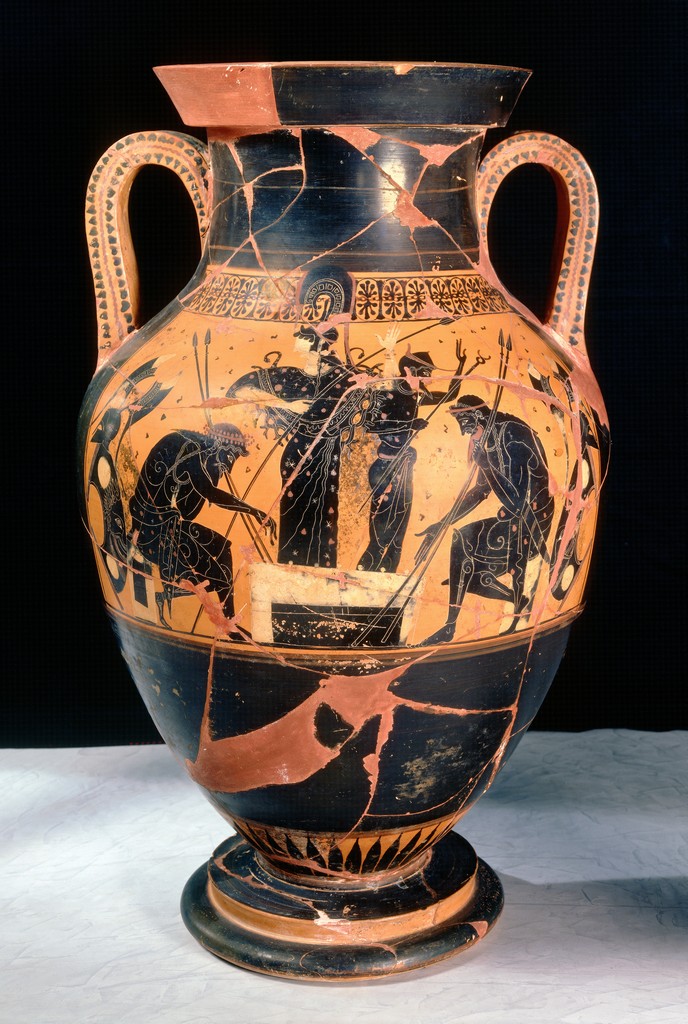
In 6th century BCE, black figure amphoras were highly-valued pottery in Classical Greece. The two-handled figures typically depict silhouettes of Greek mythology, and the silhouettes of this image are Ajax and Achilles. The two soldiers are playing a game of die at the Necropolis del Tufo in Greece. The image of these two soldiers playing die are extremely common on black figure amphoras due to the work of the painter, Exekias. Exekias’ utilization of lines, symmetrical designs, and mythological focus established the painter’s pottery as some of the most highly sought pottery in Greece and Rome. The pottery was reproduced for over 150 years following the creation of the die scene, which is the case for the amphora above as it does not have Exekias’ signature. The “Chiusi painter” that created this amphora added their own spin on the scene by placing it at a necropolis and removing the armor of Achilles. The setting of the Necropolis del Tufo, which is a cemetery, indicates that the brothers had passed into the afterlife as warriors. By juxtaposing the game next to their armors, the painter illustrates that the Greek warriors still had a nostalgic connection to the glory they achieved at the battlefield and parts of their souls are unable to abandon their previous status. A final conclusion can be made in that death levels the status achieved by warriors because Achilles is not wearing his armor in this replica, illustrating that Ajax is now his equal in death. In Exekias’ models, Achilles wore his armor to show the superior honor he had obtained in comparison to Ajax.
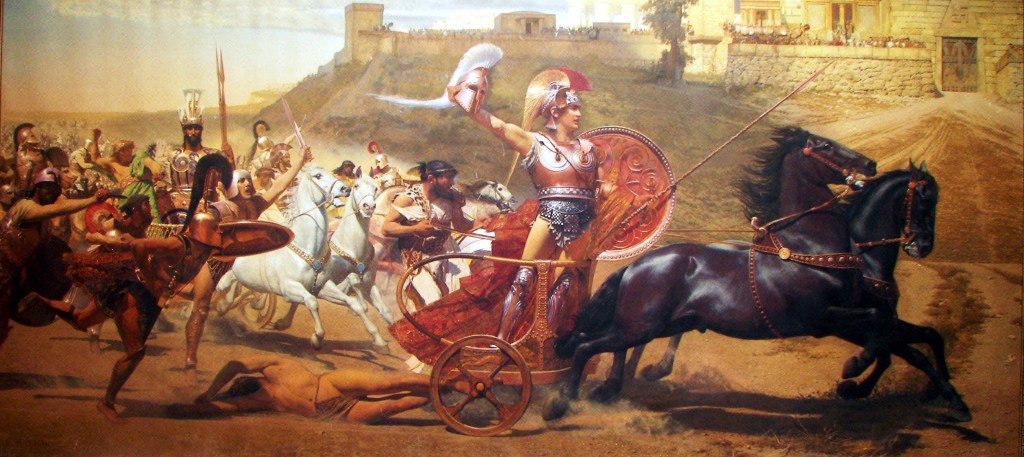
“Triumphant Achilles” was painted by Matsch in 1892 on the walls of the Achilleion Palace in Corfu, Greece. The Achilleion Palace displays multiple statues and paintings of Achilles prior to and during the Trojan War. The painting is a panoramic fresco, which depicts the vengeful celebration of Achilles by dragging Hector’s body around in front of the walls of Troy. Matsch’s shading creates a heavy focus on Achilles to emphasize his triumphant state of mind. Moreover, the attention is placed on Hector’s helmet because Greek warrior culture highlighted the glory of controlling an enemy’s armor, which is a key motif in Homer’s Iliad. The shading and the static motion of the Greek Army simulates an “action shot” that inspires feelings of intensity and power. However, the helmet and Achilles’ armor is actually an inaccurate depiction of the armor that would have existed at the time. The Mycenaean armor would have had bronze scales instead of being a single sheet of bronze, and the helmets would have lacked the bristles that are characteristic of the helmets in the painting. Although the armor is inaccurate, Matsch’s depiction of Achilles follows Homer’s Iliad in that his armor appears to demonstrate significantly higher quality than Achilles’ counterparts.
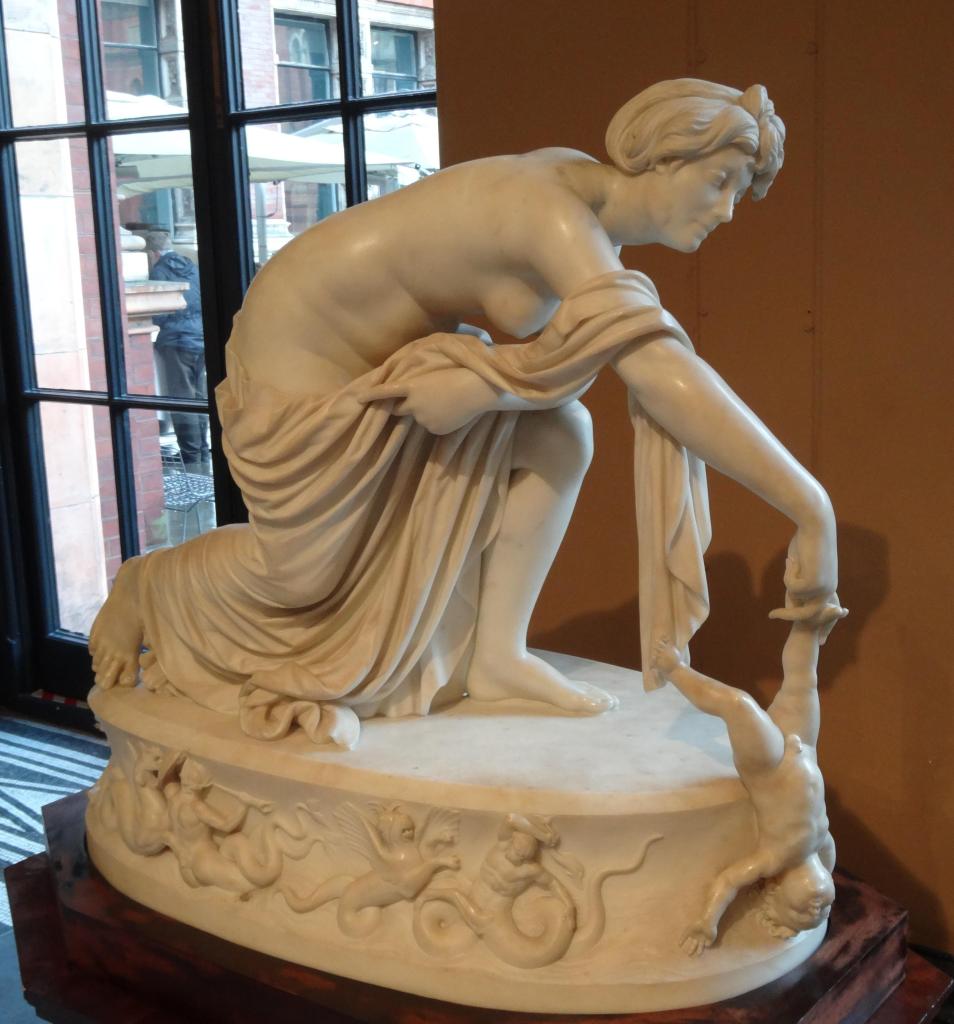
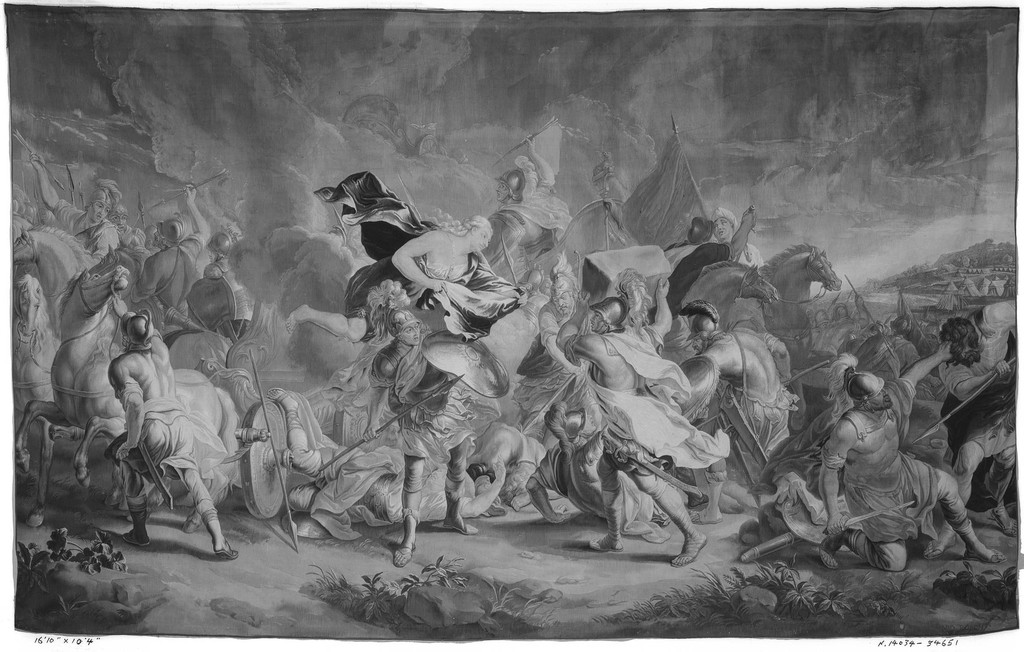
Pierre van der (Flemish, act.1712-d.1763) (workshop, attr.) [weaver]; Borght, Franz van der (Flemish, act.1720-1765) (workshop, attr.) [weaver]. (c. 1700-1742). Quarrel of Achilles and Agamemnon, Wrath of Achilles, Death of Achilles, Anger of Achilles against Agamemnon, Story of Achilles, Trojan war, Set C. Created in Brussels. 16’10” by 10’4″[Textiles – Tapestries]. Retrieved from https://library.artstor.org/asset/GETTY_GGTAP_1031176039
Toxic Heroism in Classical and Modern Times (Blog 2/17)
Regarding the article, “A School Massacre and Toxic Heroism,” the author provides a compelling argument that the heroic narrative, which has been an extremely prominent aspect of literature and life in general, instigates dangerous behavior in individuals by eliminating lifestyle ambiguity and having restricted perceptions of self-worth. The author references aspects of psychology in that humans whose actions differ from self-expectations have a mental conflict that creates destructive behavior, thereupon justifying the argument that the common heroic narrative can encourage this mental disparity.
A key example of toxic heroism occurs in the story of Ajax and the moments leading to his death. After Achilles’ armor is given to Odysseus, Ajax goes on a rampage in which he kills Greek livestock and disgraces his reputation and honor. He is unable to handle the mental ramifications of his actions and kills himself in order to relieve his shame. Ajax’s struggle is the epitome of toxic heroism because Ajax was bred upon the social construct that glory through battle defined a person’s worth, which prevented him from managing the mental conflict that occurred between his desire for glory and the social idea of shame. Paralleling contemporary belief in the heroic narrative, Ajax cannot reconcile the differences between his actions and his expectations.
In the modern world, toxic heroism still manifests itself in soldiers who return from war. In his book, American Sniper, Chris Kyle describes the struggles of returning to normal life following his time as a Marine in Afghanistan. While PTSD plays a role in that return, another central aspect is his self-perceptions of heroism that developed in Afghanistan could not be applied in the same method back home with his family, which created monumental stress in his life before he altered his perspectives. Therefore, Kyle’s life exemplifies the toxic heroism and struggles that are evident with returning soldiers today.
Theme
In Greek Mythology, Metis is a female Titan that personifies intelligence and cunningness when she creates a magic potion that helps Zeus defeat Cronus. Unfortunately, Zeus tricks and eats her, but Athena’s conception occurs prior to Metis’ death which leads to the birth of Athena straight from Zeus’ forehead. The Greeks consider Athena to be the vanguard God on intelligence and developing strategy. Consequently, the Ancient Greek characteristic of metis symbolizes paramount cunningness, which is an integral theme in the Odyssey with its representation by multiple characters. A prime example of metis in the Odyssey is Odysseus. In Book 4, Helen recollects a story in which Odysseus infiltrates the Trojan camp disguised as a beggar and kills multiple Trojan soldiers while obtaining information for the Greeks. Odysseus exemplifies the characteristic of metis due to his deceptive ability to extract information while surrounded by hostile enemies. Although Helen’s story is the first example of Odysseus’ metis, the characters within the book express veneration of his cleverness in which he seems to exhibit a divine metis that other mortals cannot possess. Furthermore, Odysseus’ metis in Helen’s story parallels the actions taken by Athena earlier on in the Odyssey when Athena disguises herself as Mentor to encourage Telemachus to go to Nestor in search of his father. The multiple moments of Athena’s cunning within the Odyssey establishes the foundation that metis is a divine characteristic, and the book portrays Odysseus on a pseudo-divine level when he utilizes his metis. Due to the epic’s central focus on divinity and Odysseus, the Odyssey is essentially a poetic appreciation of metis in that guile becomes a main method by which characters achieve a goal, such as Odysseus in his attempt to return home.
An interesting aspect of metis in the Odyssey is the gender-specific alignment of the trait. While metis has its connection to the divine, metis seems almost entirely a female personality trait in that Helen, Athena, and Penelope all exhibit varying degrees of slyness throughout the book. In contrast, the epic depicts male characters as literal and without the capacity to trick or identify trickiness, such as the suitors failing to recognize Telemachus’ plan to locate his father. The book clearly displays different gender norms in terms of metis in that females are typically the only ones who should and do exhibit sly acts. As a result, there are moments in which Odysseus is compared to the female gender with his various acts of metis. Therefore, the book highlights Odysseus’ fluidity in terms of gender roles as an indication of his cunningness as he is able to manipulate and take advantage of both brawn and intelligence. Moreover, the juxtaposition of metis with the male-oriented focus on straightforward brutishness highlights the superiority of metis in accomplishing tasks. The Odyssey’s appreciation of metis is an extension of some of the lessons within the Iliad and Sophocles’ Ajax in that cunning intelligence is considered to be a more impactful personality trait than physical skill.
Along the lines of his ability to play multiple roles to his benefit, the epic describes Odysseus as a character with “polymetis.” The term, “polymetis,” is an extension of the cleverness ideal for Odysseus as it indicates that he is clever in a variety of different situations. Prior to his departure in book 5, Odysseus questions Calypso’s willingness to assist in order to identify if he is being tricked. Odysseus’ ability to use both metis offensively and defensively is a demonstration of the skill’s mastery. Moreover, the storyline of the Odyssey aims to highlight his “polymetis” as well as the superiority of applying metis in a variety of different situations. Overall, the Odyssey’s central goal is to demonstrate the value of metis, not only for the Ancient Greek, but for application of it in all facets of life. Metis is a divine-like trait that should be located at the pinnacle of human excellence.
Bibliography 1
Donlan, W. (2002). Achilles the Ally. Arethusa, 35(1), 155–172. https://doi.org/10.1353/are.2002.0007 Dué, C. (2007). Learning Lessons from the
This section, “Achilles the Ally,” from the Arethusa journal assesses the political and cultural obligations of Achilles and Agamemnon in response to the events that occurred during the Iliad. While Agamemnon’s disrespect is an affront to Achilles’ honor, the author argues that Achilles’ reaction is not justified based on the common Mycenaean duties and societal norms of his rank. The author states Achilles should pursue means to disseminate this dishonor as a warrior, but his obligations to the Greek army, Agamemnon, and his own troops should eliminate any considerations to retire from the war. Since Agamemnon is the highest-ranking basileus and leader of the Greek army, Achilles’ inferiority to Agamemnon in terms of rank completely violates the Mycenaean political code, which damages his honor as he violates the societal norms of allegiance as well. Moreover,the author explains Achilles demonstrates significant hubris in the eyes of his constituents by equating his status to Agamemnon’s in the Iliad. The author proclaims that the Mycenaean Greeks valued skill, but there is an inherent understanding that skill does not surpass rank in times of war. For the Mycenaeans, the authority of the “wanax,” which is Agamemnon, comes from Zeus’ recognition, indicating that Achilles is essentially defying Zeus. In doing so, the author believes that the Mycenaeans and the future Greek audiences of the epic would have seen Achilles’ actions as a complete disregard for the established political and cultural traditions that dominated ancient Greece. Soldiers within the army would have actually viewed Achilles as an opponent of political stability and the Mycenaean army. The author provides a new viewpoint on the character of Achilles and establishes Achilles’ actions within the framework of Mycenaean political and social requirements. The article aims to reconstruct the image of Achilles that developed from the Iliad as the epic dramatically influences our perspective that Agamemnon is mostly at fault for damaging the reputation of Achilles and the damages to the Greek army. Furthermore, the article helps the audience compare current societal value for merit and skill over the ancient system of Greek rank and hierarchy to catalyze a greater understanding of Mycenaean politics and events that follow the warriors’ quarrel. Overall, the author changes how the audience of the Iliad should view Achilles.
Burgess, J. (1995). Achilles’ Heel: The Death of Achilles in Ancient Myth. Classical Antiquity, 14(2), 217–244. JSTOR. https://doi.org/10.2307/25011021
In Burgess’ article, Achilles’ Heel: The Death of Achilles in Ancient Myth, the author assesses when the idea of Achilles’ invulnerability developed in Classical History. Burgess claims that the common belief in which Achilles is invulnerable except his Achilles’ heel is a common misconception in contemporary understanding. Burgess argues that the Classical Greeks only believed that the Styx “hardens the skin” of Achilles without making him immortal. Moreover, he argues that the early Roman Empire incited this belief as Classical art and literature never depicted Achilles dying from the Paris’ shot into his heel. The Roman painting and Amphora show Achilles in a state where he is in visible anguish to the arrow and “swooning” over the wound, thereupon demonstrating the fatality of the wound. In Ancient Greek art, the wound appears to be more of a nuisance and a detriment to Achilles’ mobility. There are also other artworks in which Achilles has large wounds to his chest that appear to be fatal according to Burgess. Burgess parallels Achilles’ death to Patroclus’ death in that Apollo intervened by guiding Paris’ arrow to Achilles’ ankle, which makes Achilles susceptible to attacks from Trojan warriors due to the lack of mobility imposed by the wound. By altering the perception of Achilles’ invulnerability, the article provides a greater appreciation for Achilles and his success as a warrior. Additionally, it furnishes a novel understanding as to why Achilles was glorified in Ancient and Classical Greece because Achilles was considered to be resistant to damage with his skin but was not invincible. For these Greeks, Achilles’ seeming invincibility would have been attributed more to his skill as a warrior as there was no notion of imperfect invulnerability prior to Rome. Therefore, Achilles’ skill as a warrior should be a greater testament to his success and to his reputation in order to fully appreciate him in Greek mythology.
Trojan War: Briseis and the Theme of Force. College Literature, 34(2), 229–262. https://doi.org/10.1353/lit.2007.0014
Francis, J. A. (2009). Metal Maidens, Achilles’ Shield, and Pandora: The Beginnings of “Ekphrasis.” American Journal of Philology, 130(1), 1–23. https://doi.org/10.1353/ajp.0.0038
Roisman, J. (2008). Greek Perspectives on the Justness and Merits of the Trojan War. College Literature, 35(4), 97–109. https://doi.org/10.1353/lit.0.0023
Wilson, J. P. (2007). Homer and the Will of Zeus. College Literature, 34(2), 150–173. https://doi.org/10.1353/lit.2007.0025
Within the article, the author, J.P. Wilson, examines the relationship between the will of Zeus and the will of the poet of the Iliad to the life events and character of Achilles. Wilson’s assessment of the Iliad demonstrates how influential Zeus’ will is on Achilles’ actions in the Trojan war and the minimal control Achilles has over his own life. By killing Patroclus, the will of Zeus subverts the will of Achilles by enraging Achilles and putting into motion the events that will allow Achilles to achieve kleos, despite the understanding that Achilles will quickly perish once his glory is attained. On the other hand, Achilles’ will wants Patroclus to survive, but an even bigger consideration is that he begins to question his purpose for being at the war. The author considers Achilles’ argument with the embassy in which Achilles wonders if his true motivations and happiness lie in achieving a short, glorious life versus one that is long. Consequently, the author demonstrates that Achilles is merely a main character in Zeus’ plot with insignificant control over how he spends his life. Moreover, Wilson also expresses how the will of Zeus is metaphorical for the will of Homer. The epic cycle necessitates the use of a main character that experiences struggle and success around the Trojan War, therefore requiring Homer to focus on Achilles. As such, the author believes the “will of Zeus” is basically a means by which Homer can establish the events and storyline that lead Achilles to his redemption and glory in the Iliad. By stating this claim, the author alters the audience’s understanding of the Greek warrior. Instead of being in control of his own life, the audience learns from Wilson that Achilles is truly only a puppet that is manipulated by the poet’s will to generate an entertaining epic. While Achilles’ success on the battlefield deserves merit, the audience recognizes that Achilles would never have reached that point without the will of Zeus, and especially of Homer. The audience begins to pity Achilles in that he does not have a voice in how his life turns out, which reaffirms Achilles’ struggles and valor prior to the final moments in his short life. Finally, the lack of control the author emphasizes lowers the audience’s esteem for Achilles as all of his success can be attributed to Zeus and Homer.
Blog Post 3: Odysseus Is At Fault (3/23)
Odysseus’ inability to identify the problem and prevent his men from violating the guidelines set out by Circe is truly the reason for his struggles instead of the blame he places on the Gods. As the food runs out, Odysseus fails to reestablish the importance of following Circe’s instructions and allows his men to act on their own volition by praying away from the campsite. Despite his intelligence, his lack of foresight is to blame because Circe’s instructions clearly identify avoiding the island in order to prevent any conflicts with the Gods. Additionally, Odysseus should understand that humans are not immortal and experience hunger, therefore demonstrating that Odysseus should never have left his crew alone. Even if the Gods made him tired or created a wind that prevented their departure, his failure as a leader and his inability to recognize the dangers of leaving his men alone with cattle places more fault on him than on the Gods.
Bibliography 2
Dolmage, J. (2009). Metis, μῆτις, mestiza, Medusa: Rhetorical bodies across rhetorical traditions. Rhetoric Review, 28(1), 1–28. https://doi.org/10.1080/07350190802540690
Dougherty, C. (2015). NOBODY’S HOME: METIS, IMPROVISATION AND THE INSTABILITY OF RETURN IN HOMER’S ODYSSEY. Ramus, 44(1–2), 115–140. https://doi.org/10.1017/rmu.2015.6
In Dougherty’s passage, the author analyzes the theme of metis with an improvisatory framework in order to redefine contemporary understanding of the term in relationship to Odysseus’ heroism. A fundamental aspect of Odysseus’ metis is his reliance on anonymity throughout the book. Dougherty argues that his reliance on anonymity, especially when he relinquishes his name in the Cyclop’s den, leads to a cascade of events in which Odysseus’ identity becomes chameleonic by allowing him to change personalities to match a situation. In doing so, the author believes his identity of nonconformity is essentially the output of his metis, rather than being a tool for his heroism. Dougherty indicates Odysseus’ metis catalyzes his improvisational ability because it requires tremendous situational awareness and cognition to develop strategies in dangerous moments. Furthermore, Dougherty references previous definitions of metis in which the term is defined as the tactful mastery of a skill that proves essential to a Greek figure. Consequently, Dougherty argues that Odysseus’ successful improvisational ability is his metis. Another key aspect of Dougherty’s argument is that by accepting metis over other unimportant desires in life, a person is able to reinvent himself. The author believes that Odysseus places a majority of his values into his metis when he refers to himself as “Noman” in the books. Therefore, Odysseus severs any formal ties of honor to his name and humiliates himself entirely, which transforms his identity to match the malleable state that he exemplifies when he meets Athena on Ithaca or when he encounters Nausicaa. Dougherty demonstrates that his improvisational ability, or his metis, becomes Odysseus’ identity, and this change of identity from traditional Greek hero to cunning agent is the basis for which he believes metis causes Odysseus’ reinvention. By comparing metis to the traditional Greek hero, Dougherty adds to the theme of the Odyssey by demonstrating that the traditional Greek hero, such as Achilles, is stubborn with his morals and can only succeed in certain moments. On the contrary, the improvisational ability of metis supersedes the Greek warrior as a cunning figure, such as Odysseus, can thrive in any situation with his adaptability.
Friedrich, R. (1987). Heroic Man and “Polymetis”: Odysseus in the “Cyclopeia.” Greek, Roman and Byzantine Studies; Cambridge, Mass., Etc., 28(2), 121–133.
In Friedrich’s book, Heroic Man and Polymetis: Odysseus in the Cyclopeia, Friedrich assesses Odysseus’ polymetis in respect to Odysseus’ time on the Cyclops’ Island. Although there are multiple moments where Odysseus’ metis seems to supersede most humans, Friedrich addresses the conflicting moments of stupidity when Odysseus places him and his crew in serious danger by staying in the Cyclop’s den. The author explains that his intellectual curiosity may have encouraged Odysseus to stay in this dangerous situation, but he demonstrates that Odysseus’ concern with gifts throughout the book is the major factor as Odysseus strongly desires to maintain the “Heroic Code” with his extravagant return to Ithaca. Consequently, the author depicts a conflict between metis and traditional Greek heroism in that Odysseus values his honor over his intelligence, despite the epic’s focus on the theme of metis. Furthermore, Friedrich believes Homer juxtaposed examples of metis and traditional heroism in order to invalidate the importance of honor and emphasize the superiority of intellectual thought and curiosity. Friedrich furthers his point by analyzing Odysseus’ response to the Cyclop’s primal world. He states that Odysseus comes to recognize the limitations of his heroic code when Odysseus realizes that honor has value to the monstrous Cyclops. Therefore, Friedrich illustrates how metis is superior to honor on two fronts: Odysseus’ metis would have prevented the torture experienced by the Cyclops, and his metis also allows Odysseus and his crew to escape alive. Lastly, Friedrich evaluates the importance of Odysseus revoking his name to Homer’s theme of metis outweighing honor. By calling himself a “Nobody,” Odysseus removes any honor associated with his name and truly dissociates from traditional Greek heroism for a brief moment. In doing so, Friedrich explains that Odysseus becomes the quintessential example of metis in that moment. Odysseus’ utter rejection of the heroic code allows metis to reign supreme for a moment and permits the tricky escape of the crew. Friedrich believes that Homer attempts to associate metis with a new form of heroism as Odysseus’ metis allows him to receive the reputational honor associated with saving the crew, thereby satisfying a hero’s necessity to receive honor. Essentially, metis is a characteristic that allows a hero to succeed without the need for brute strength and skill, indicating that metis outperforms traditional Greek heroism. Overall, Friedrich provides a key perspective of Homer’s emphasis on metis over traditional honor. His assessment of Odysseus’ transformation through the Cyclop’s books illustrates the degree to which Homer finds metis superior to honor, especially with Odysseus’ elimination of any honor associated with his name.
Holmberg, I. (1997). The Sign of Metis. Arethusa, 30(1), 1–33. https://doi.org/10.1353/are.1997.0003
Nobus, D. (2006). Polymetis Freud: Some Reflections on the Psychoanalytic Significance of Homer’s Odyssey. Comparative Literature Studies, 43(3), 252–268. https://doi.org/10.1353/cls.2007.0006
Williams, H. (2018). POLYMETIC HEROISM IN THE WANDERINGS OF ODYSSEUS, ODYSSEY 9-12 (THE APOLOGUE). Akroterion, 63, 1-. Gale Literature Resource Center.
In Polymetic Heroism in the Wanderings of Odysseus, Williams analyzes the application of metis with bie in Odysseus’ wanderings in order to illustrate the fundamental aspect of metis in heroism. In Greek mythology, bie is defined as the unrestrained use of raw anger or force. Williams first assesses the relationship between bie and metis in Odysseus’ attempt to free his crew from the Cyclop’s capture. The author draws upon book 9 in which Odysseus considers fatally stabbing Polyphemus, but he restrains himself as he realizes that killing the Cyclops would prevent their escape as the crew could not move the heavy boulder. Instead, Odysseus stabs the Cyclops in the eye in an attempt to blind the Cyclops, agitate him, and allow for the crew’s escape as Polyphemus has to let the sheep out to feed. By restraining himself with his metis, Williams concludes that Odysseus’ attack on Polyphemus’ eye is indicative of the fusion of bie and metis. Therefore, Williams believes that metis is essentially the antithesis of bie because the application of metis to Odysseus’ bie creates a controlled, effective attack that secures the crew’s escape. Furthermore, Williams demonstrates that metis would be unsuccessful in achieving their escape because Odysseus’ use of bie makes it extremely difficult for Polyphemus to catch the crew as they escape on the sheeps’ stomachs. In addition to restraint, Williams references how Odysseus’ preemptively coordinates the suitors’ demise by encouraging the removal of weapons and armor. Williams indicates that metis not only restrains the detrimental effects of unrestrained bie, but metis also permits bie to act to bie’s full extent due to Odysseus’ recognition of his future failure if the suitors have weapons. Consequently, the author concludes that the Odyssey attempts to show that the paramount Greek hero is one who can effectively use intelligence in tandem with bie to create successful, coordinated attacks. To conclude, Williams redefines the traditional Greek hero in classical analysis of Greek epics, thereupon creating an alternate perspective for analysts to interpret heroic behavior.
Redefining Metis (Final Essay)
Throughout the Epic Cycle, Greek heroes exhibit various characteristics that come to define their personality. For Achilles, it is his skill in battle, valor, and dedication to honor. For Nestor, his prudence and sensibility surpasses all other humans. For Agamemnon, his até characterizes most of his decisions and their major repercussions. Although not all the traits are beneficial, every character becomes the personification of these traits and a symbol by which the author can illustrate a theme. The characteristic of metis is deeply embedded into Homer’s Odyssey. The main character, Odysseus, symbolizes metis to the point where Odysseus seems to parallel Athena’s divine metis. In contemporary understanding, metis is intelligence that allows a character to achieve their goals through deceit or avoidance. Odysseus employs tricks in multiple forms to return to Ithaca and reclaim his throne. However, Odysseus’ intelligence does not always involve the use of deceit to help him succeed. Rather, his metis employs a variety of mechanisms that help him obtain his goals throughout the epic. Therefore, contemporary definition of metis needs to be reconsidered in order to accurately describe and understand its application. Instead of a cunning intelligence, metis is a situational awareness that allows a character to obtain their goals, while rapidly adjusting their personality and plan to accommodate unforeseen circumstances.
Similar to a chess grandmaster, characters in Greek mythology apply metis by creating strategies to best accommodate all of the pieces in play and effectively utilize their benefit or minimize the threat. A key example of strategy-building occurs when Odysseus and Telemachus preemptively mitigate the danger to their lives. Prior to the assault on the suitors, Odysseus and his son remove all of the weapons from the hall and place them in the storage room (Homer & Lombardo, 2000, 19.30-35). Odysseus demonstrates that he is utilizing a strategy because the removal of the weapons decreases the suitors’ potential to harm him and Telemachus when the assault occurs. In this moment, Odysseus’ strategy embodies his metis as the creation of his strategy centers around the situational assessment of his largest threats. Odysseus understands that he exhibits more skill and battle prowess than the suitors due to his experience in the Trojan War, but he realizes that the suitors’ sheer numbers would vastly supersede his skill if they have access to weapons. Odysseus is also aware that the greatest opportunity for his plan to succeed would be to systematically remove anything that presents a challenge to him, thereupon eliminating the opportunities for failure. In addition to removing the weapons, Odysseus tells Telemachus to explain to the suitors that Telemachus hid the weapons in order to prevent injury if fighting occured when the suitors were drunk (Homer & Lombardo, 2000, 19.4-19.13). Odysseus demonstrates his situational awareness by anticipating and addressing the next major foil to his plot. He provides Telemachus with a reason for hiding the weapons that appeals to the suitors logically, which would allow his plan to continue unimpeded. As a result, Odysseus’ metis enables the hero to anticipate moves by his opponents, allowing him to remain multiple steps ahead in a given situation. Furthermore, his metis is demonstrated by his ability to create a strategy that amplifies the effectiveness of his strengths, exploit the suitors’ weaknesses, and debase their strength in numbers. In comparison to her husband, Penelope exhibits a level of metis that allows her to build a strategy to ward off the suitors’ advancements for marriage. When Odysseus is still disguised as a beggar, Penelope reveals her strategy to fend off the suitors by weaving a robe during the day and unweaving it at night as she would choose a suitor once she was done with the task (Homer & Lombardo, 2000, 19.145-163). Similar to Odysseus, Penelope’s strategy exemplifies that she was situationally aware of her own strengths and weaknesses, permitting her to create an effective strategy that would increase the time Odysseus had to return home. Moreover, her personal awareness is basically an extension of her metis because it allows her to understand her role in the context around her. As such, Penelope’s metis allows her to recognize she has minimal authority over the suitors, and the best plan for her would be to play defensively rather than offensively. On the other hand, Odysseus uses his metis to develop a strategy that is more offensive as he recognizes the necessity of killing the suitors in order to eliminate any threat to his home and his honor. These two cases illustrate that metis is not merely understanding and developing strategy. Rather, metis is a situational awareness of one’s role in a given context, which helps a character achieve their objectives by enabling the creation of the most effective strategy.
As every plan cannot anticipate the inevitable changes that occur, metis gives characters the ability to adapt effectively to a conflict as well. A prime example of his adaptability materializes when Nausicaa and Odysseus encounter each other for the first time. Although he has no plan in place, Odysseus considers whether he should fall to her knees and beg for her help or stand from a distance and use charm to get to the city (Homer & Lombardo, 2000, 6.141-144). Since he considers two different methods, Odysseus signifies that he is capable of adapting into any role that fits effectively into this situation. Odysseus’ adaptability in this unexpected circumstance conveys his metis because he is aware of Nausicaa’s perspective of him being a potential threat. Consequently, Odysseus assesses the best possible role that would mitigate Nausicaa’s concern and help him get closer to King Alcinous for help, which would be impossible if he had not understood the situation and his role in it. Another example of metis and its relationship with adaptability occurs when Odysseus and his crew are in Polyphemus’ cave. Prior to the crew’s escape attempt, Polyphemus asks for Odysseus’ name, and the hero responds with the pseudonym of “Noman” (Homer & Lombardo, 2000, 9.364-365). When other Cyclops asks Polyphemus why he is yelling in pain, the Cyclops explains that “Noman” tricked him, which eases the suspicion of his neighbors and sets them on their way (Homer & Lombardo, 2000, 9.407-412). Odysseus’ metis is portrayed in his adaptability as he reacts instinctually to the Cyclops’ question in order to hide his identity. Despite not planning for the question, Odysseus also utilizes the moment to his advantage as he is aware that the Cyclops would be in pain and alerting the other Cyclops. The intelligence to refer to himself as “Noman” secures his goal to escape the island without any more losses because Polyphemus’ neighbors would have seen the crew as food and overwhelmed their ranks. In this case, metis does not merely involve the trick to refer to himself as “Noman.” Metis denotes the situational awareness to anticipate developing problems and address them rapidly by adapting his plan, and the false name is a mechanism by which he can adapt his plan and secure the safety of the crew with their escape. In addition to quickly adapting his plan to his advantage, Odysseus constantly analyzes his surroundings, which epitomizes the relationship between his metis and his adaptability. When Odysseus lands at the Island of Scheria and the Island of the Cyclops, Odysseus internally questions the demeanor of the Islands’ inhabitants to see if they will be benevolent or dangerous (Homer & Lombardo, 2000, 6.117-120 & 9.169-171). Odysseus’ questioning of the foreign environments indicates the use of his metis because he is trying to become aware of his surroundings and constantly readjusts his interpretation in order to most effectively adapt to his changing environment. Accordingly, metis catalyzes Odysseus’ adaptability due to the necessity of understanding his environment in order to even be able to adapt appropriately. Although metis is essential for proper adaptation to occur, adaptation is a fundamental process in metis as well. Since Odysseus constantly analyzes his environment, he must adapt his interpretation of his surroundings to accommodate any new information, therefore demonstrating that metis is a product of adapting one’s mental understanding of the situation. An interesting assessment of the relationship between adaptability and metis is the idea that it is improvisational in nature. An improvising actor finds that his self-understanding is equally important to that of his audience’s interpretation, so he attempts to comprehend his own behavior and eventually adapts to become an incarnation of the role (Dougherty, 2015). In this sense, Odysseus is not merely a character with a specific identity that can alter in small amounts to accommodate changing surroundings. Rather, Odysseus’ metis marshals in his improvisational adaptability. Through his metis, Odysseus’ identity transforms into the role he is playing, which allows him to effectively maneuver his environment as he constantly assesses his relationship with his surroundings. To conclude, metis and adaptability are both inputs and outputs of each other because adapting improves one’s situational awareness. Similarly, improving situational awareness allows a character to adapt more effectively.
A paramount characteristic of metis in the Odyssey is the use of experience and knowledge to practically address a problem in the situation. After disguised Athena asks where Odysseus comes from when he wakes up on Ithaca, Odysseus provides a false story that he is a Cretan man who was dropped upon the Island by the Phoenicians (Homer & Lombardo, 2000, 13.265-294). Odysseus’ decision to release false information indicates he is utilizing past experience to address Athena because a lack of knowledge of his location could prove detrimental to his life if he released his identity. If his identity is recognized, the island’s inhabitants could immediately view him as a threat. As such, Odysseus applies his experience with anonymity to protect himself until he comprehends his location. Moreover, Odysseus also utilizes his experience with Troy and being dropped on Ithaca by the Phaeacians to build his identity. In this moment, Odysseus depicts his metis as he is aware that he knows nothing of his surroundings. Therefore, his metis forces the use of deceit and anonymity because his past experience dictates that the most effective strategy for survival would be to play a neutral character. Additionally, he recognizes that an artificial story is easier to remember and more believable if it has inklings of his experiences, thereby illustrating that metis allows him to apply his experiences in the most effective way. Past experience influences his decisions in his dealings with Calypso and the Gods. Although Calypso allows him to leave once Odysseus builds a raft, he questions her motives and states that he will only leave if she guarantees his safety (Homer& Lombardo, 2000, 5.172-178). Odysseus’ past experience with Poseidon influences his decisions because he realizes that not all the Gods support him. Consequently, he becomes aware of potential tricks, resulting in the decision to have Calypso swear an oath for his safety. In Greek Mythology, a sworn oath on the River Styx is binding, so it successfully prevents any obstacles and danger from Calypso. The situational awareness to have Calypso swear an oath is a product of past experiences with the Gods, indicating that metis becomes more effective as experiences grow. Without his experience with Poseidon, Odysseus would not be able to recognize the future implications of allowing a God to do as they please. Instead, Poseidon’s challenges helps Odysseus recognize the underhandedness of the Gods, which promotes safer decision-making when he deals with a Greek deity. Similar to adaptability, metis draws on past experiences to effectively make decisions. Likewise, past experiences improve the awareness of Odysseus in various contexts.
While metis’ original definition of “cunning intelligence” is evident in the Odyssey, “cunning intelligence” is an extension of having significant situational awareness to constructively address obstacles and achieve one’s goals. It is important to first address the meaning of “cunning intelligence.” Within Polymetic Heroism In The Wanderings of Odysseus, the author determines that metis most directly means the ability to apply deceit in order to achieve a goal (Williams, 2018). Furthermore, the author places the definition in the context of Odysseus’ trick as “noman” and his crew’s escape from Polyphemus’ lair by demonstrating that Odysseus embodies this “cunning intelligence” (Williams, 2018). In actuality, Odysseus’ ability to apply his tricks and guile is more of an extension of situational awareness than it is his most defining characteristic. He utilizes tricks in order to achieve his goal of escape because he recognizes that his current situation in the Cyclops’ den requires the use of deceit. The pseudonym of “noman” is not solely the result of “cunning intelligence” either. The creation of that pseudonym is the product of strategy-building, adaptability, and past experience. The strategy he builds focuses on two primary objectives: The first objective is escaping, and the second objective is securing the safety of his crew. Before the Cyclops’ asks him his name, Odysseus knows the escape path, but he does not recognize a way to protect the lives of his crew. However, he discerns that Polyphemus’ questioning of his name is an opportunity to successfully achieve the second objective because the pseudonym would place neighboring Cyclops at ease if they ask why Polyphemus is in pain. Therefore, he quickly adapts his identity and strategy to take advantage of this opportunity. Additionally, his past experiences also play a role in the creation of his pseudonym because he is aware that the most effective methods to defeat more powerful enemies is with deceit. Odysseus’ entire strategy depends minimally on aggression and significantly on cunningly maneuvering the overwhelming strength of the Cyclops. As a result, the pseudonym of “noman” falls within the parameters of deceit that his experience indicates is the best option. Adaptability, effective strategy-building, and the application of past experiences are significantly interdependent with metis as situational intelligence permits the utilization of these traits. Since the pseudonym is a product of these traits, it can be concluded that the original definition of metis does not accurately encompass its true meaning as his “cunning intelligence” in his escape from the den is merely a product of his situational awareness. If Odysseus is the embodiment of metis, then metis must be defined as “exceptional situational awareness” because his awareness is the most crucial factor in his success as a Greek hero.
Overall, the characteristic of being situationally aware of one’s surroundings in order to achieve specific goals is the most accurate definition of metis in the context of the Odyssey. Odysseus’ metis allows him to adapt to various situations, build strategies, and practically apply past experience to make the best decisions. These three traits also construct Odysseus’ metis by increasing the understanding he has of his situation and his role in it. Moreover, the original definition of metis is inaccurate because Odysseus’ “cunning intelligence” stems from his awareness of his surroundings. With this in mind, the new definition of metis provides a different perspective on the character of Odysseus. Odysseus is not merely a character who often uses deceit to succeed. Rather, Odysseus is an ambitious character who constantly assesses the relationship between his current role in a situation and the context itself. Like the improvising actor, he is the product of his surroundings as he constantly manipulates his identity to fit appropriately into any given situation. His situational awareness is the sole reason why he is appreciated as an atypical Greek hero because he demonstrates that intelligence can supersede the typical attributes of brawn and skill.
Final Essay References
Dougherty, C. (2015). NOBODY’S HOME: METIS, IMPROVISATION AND THE INSTABILITY OF RETURN IN HOMER’S ODYSSEY. Ramus, 44(1–2), 115–140. https://doi.org/10.1017/rmu.2015.6
Homer., & Lombardo, S. (2000). The essential Homer: Selections from the Iliad and the Odyssey. Indianapolis: Hackett.
Williams, H. (2018). POLYMETIC HEROISM IN THE WANDERINGS OF ODYSSEUS, ODYSSEY 9-12 (THE APOLOGUE). Akroterion, 63, 1-. Gale Literature Resource Center.
 Achilles: Hero of the Trojan War
_(3278859760).jpg)
